
Uncategorized
Energy Efficiency as a Strategic Advantage in Modern Mining Operations
By MinersHub Team · March 22, 2026
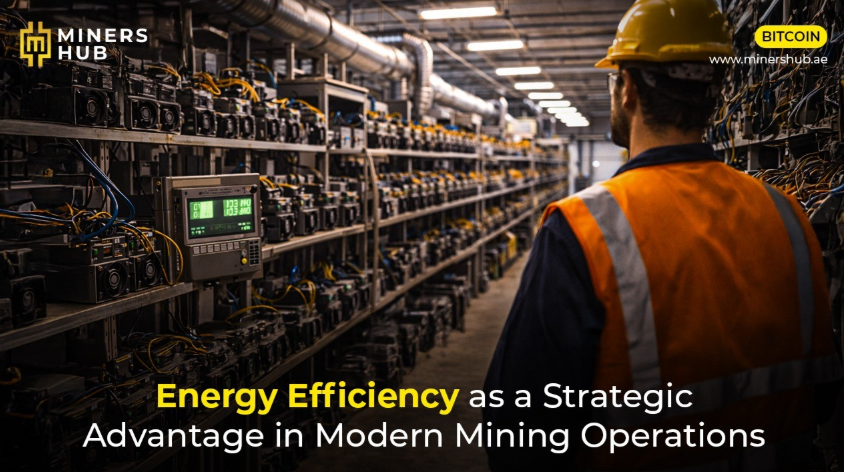
Energy sits at the center of every large-scale mining operation. Power determines not only whether machines can run, but how reliably, how economically, and how sustainably an entire facility can function over time.
As mining has evolved into an industrial activity, energy management has shifted from being a background utility to becoming one of the most important strategic disciplines in the business.
At MINERS HUB, efficiency is treated as a design principle, not a retrofit. From the earliest planning stages of mining farms and hosting facilities, electrical systems, cooling infrastructure, and rack layouts are engineered to minimize waste and maximize productive output.
Energy as Infrastructure, Not Just Input
In small setups, power is often viewed simply as something that comes from the wall. In industrial environments, electricity becomes a complex system that must be planned, distributed, protected, and optimized.
Professional farms rely on:
* High-capacity substations
* Dedicated transformers
* Load-balanced power corridors
* Intelligent power distribution units
* Surge protection and grounding systems
* Redundant feeds and backup pathways
Each of these elements works together to ensure stable supply across thousands of machines.
At MINERS HUB, electrical architecture is designed with future growth in mind. Facilities are not built to meet only current load requirements; they are engineered to accommodate higher-density deployments as hardware generations advance.
Power Usage Effectiveness and Facility Design
One of the most widely used benchmarks in data-center-style environments is power usage effectiveness (PUE), which measures how much total facility energy is required to deliver one unit of power to computing equipment.
Lower ratios indicate greater efficiency.
Improving this metric requires holistic design:
* Optimized airflow to reduce fan strain
* Shorter electrical pathways
* Efficient transformers
* High-performance cooling systems
* Rack layouts that minimize heat recirculation
MINERS HUB incorporates these principles directly into farm layouts, ensuring that energy flows to machines with minimal loss and that excess heat is removed with as little additional power as possible.
This approach benefits both operational stability and long-term sustainability.
Cooling: The Largest Energy Lever
In most mining farms, cooling consumes a significant portion of total facility energy. Managing thermal output efficiently is therefore one of the most impactful ways to improve overall performance.
Modern cooling strategies include:
* Hot-aisle and cold-aisle containment
* Evaporative or adiabatic cooling where climate permits
* Variable-speed fans
* Liquid-assisted or immersion systems
* Temperature zoning
* AI-driven airflow optimization
At MINERS HUB, cooling solutions are selected based on geography, climate conditions, and machine density. No single approach fits every site.
Sensors distributed throughout facilities continuously collect temperature and humidity data, allowing systems to adjust dynamically and maintain optimal conditions.
This adaptive approach reduces unnecessary power draw while protecting hardware.
Intelligent Load Distribution
Energy efficiency is not achieved only at the facility level—it must also be managed at the rack and machine level.
Professional environments deploy:
* Smart PDUs with real-time metering
* Rack-level power analytics
* Automated load balancing
* Alert systems for anomalies
* Historical usage tracking
These tools allow operators to detect inefficiencies early, redistribute load before circuits become stressed, and identify underperforming equipment.
MINERS HUB uses these insights to fine-tune deployments and ensure that every kilowatt contributes productively to computing activity.
Sustainability and Long-Term Viability
While reliability remains the primary goal, sustainability is becoming an increasingly important consideration in infrastructure design.
Energy-efficient operations:
* Reduce strain on local grids
* Support regulatory compliance
* Improve long-term operating stability
* Enable integration with diverse energy sources
* Strengthen corporate responsibility initiatives
MINERS HUB designs facilities capable of adapting to evolving energy landscapes, incorporating flexible power systems that can integrate with alternative energy sources where appropriate.
Efficiency, in this context, becomes both an operational advantage and a forward-looking strategy.
Efficiency as a Competitive Differentiator
Over time, small gains in energy optimization compound into significant operational advantages.
Efficient facilities deliver:
* Lower cooling overhead
* More predictable electrical performance
* Reduced thermal stress on hardware
* Longer equipment lifespans
* Easier scalability
* More stable operating environments
At MINERS HUB, energy management is viewed as a continuous process rather than a one-time design decision.
Facilities evolve as technology advances, always pushing toward higher density and lower waste.
Because in industrial mining, efficiency is not optional, it is foundational.