
Uncategorized
Inside a Modern Mining Farm: Where Performance Is Engineered
By MinersHub Team · March 22, 2026
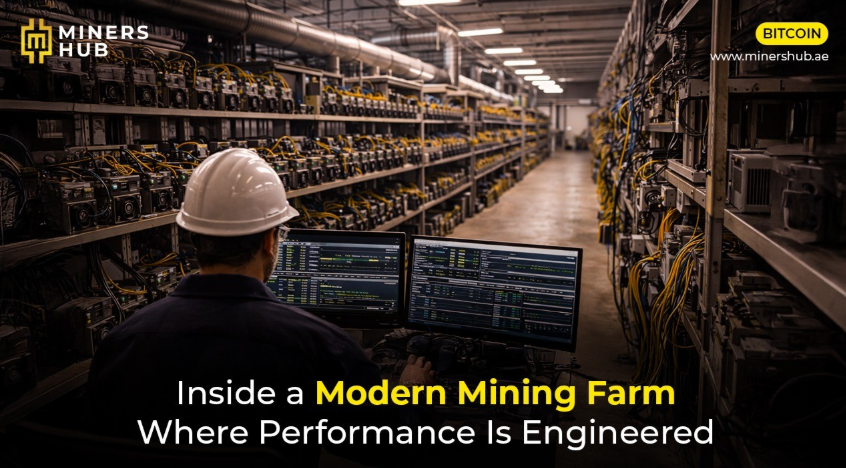
To an outside observer, a mining farm may appear to be nothing more than long aisles of machines humming in unison. In reality, high-performance mining farms are among the most complex industrial environments in the digital economy.
Every successful facility is a carefully balanced ecosystem where electrical engineering, thermal science, mechanical design, digital monitoring, and human operations converge.
At MINERS HUB, mining farms are conceived not as storage spaces for hardware, but as precision-engineered environments designed to sustain continuous, large-scale computation.
Mining Farms Have Become Industrial Facilities
As hardware has grown more powerful, the density of machines per square meter has increased dramatically. This shift has transformed mining farms into energy-intensive, heat-dense industrial operations.
Modern facilities must manage:
• Megawatt-scale electrical loads • High-velocity airflow systems • Redundant power delivery • Complex cabling architectures • Fire-suppression frameworks • Environmental monitoring networks • Physical access control
This level of complexity demands engineering disciplines typically found in large data centers or industrial plants.
MINERS HUB applies these same principles to its farms, designing layouts, rack systems, and electrical pathways that support both present-day requirements and future expansion.
Power Distribution: The Arteries of the Farm
Electricity is the lifeblood of mining operations. Delivering it safely, efficiently, and consistently across hundreds or thousands of machines is one of the most technically demanding aspects of farm design.
Professional farms rely on:
• High-capacity transformers • Structured power distribution units • Load-balanced circuits • Surge protection systems • Backup feeds and redundancy layers • Continuous electrical monitoring
Poorly designed power infrastructure can cause localized outages, equipment damage, and cascading failures across entire rows of machines.
At MINERS HUB, electrical architecture is planned at the rack level, ensuring that each deployment receives stable supply without overloading individual circuits.
Power systems are also built with modularity in mind, allowing new capacity to be added without disrupting existing operations.
Thermal Engineering and Airflow Management
Every watt consumed by a mining machine ultimately becomes heat.
Removing that heat efficiently is not optional, it is central to maintaining performance and protecting hardware.
Modern mining farms employ:
• Hot-aisle and cold-aisle containment • High-volume exhaust systems • Directed airflow channels • Temperature zoning • Liquid-assisted cooling where appropriate • Sensor-driven climate controls
MINERS HUB designs airflow pathways before machines are ever installed. Computational models are used to predict heat movement, identify potential hot spots, and optimize fan placement and exhaust routes.
Sensors embedded throughout the facility continuously measure temperature, humidity, and air pressure, allowing technicians to make real-time adjustments.
This precision keeps machines operating within ideal thermal ranges, extending their lifespan and stabilizing output.
Monitoring Systems: The Nervous System of the Farm
In large-scale environments, manual inspection is no longer sufficient.
Modern farms depend on comprehensive monitoring platforms that provide visibility into every layer of operation.
These systems track:
• Machine health • Power consumption • Temperature distribution • Network connectivity • Rack-level performance • Error rates and alerts
At MINERS HUB, monitoring dashboards are active 24/7, enabling teams to identify irregularities before they escalate into failures.
Predictive analytics help schedule maintenance at optimal times, minimizing disruption while preventing unexpected shutdowns.
This shift from reactive troubleshooting to proactive management defines professional-grade farm operations.
Preventive Maintenance as an Operating Principle
Downtime is rarely caused by catastrophic failure alone. More often, it emerges from small issues that go unnoticed, dust accumulation, failing fans, loose connectors, thermal imbalances.
Professional farms implement disciplined maintenance regimes, including:
• Scheduled cleaning cycles • Component inspections • Firmware checks • Thermal audits • Electrical integrity tests • Spare-parts inventories
MINERS HUB integrates maintenance into daily operations, ensuring machines remain in optimal condition and that wear is addressed before it affects performance.
This systematic approach protects capital investments and supports long-term operational stability.
Security Inside the Facility
Mining farms house high-value equipment and must therefore operate under strict security protocols.
Facilities incorporate:
• Multi-layer access control • Biometric or badge-based entry systems • Surveillance coverage across aisles • Secure cages for client deployments • Network isolation frameworks • Incident-response planning
At MINERS HUB, security is designed into the layout of the farm itself, separating public, technical, and restricted zones and logging every access event.
This layered approach safeguards assets while maintaining operational efficiency.
Designing for Growth
The most sophisticated farms are not static. They are living systems that evolve as hardware advances and capacity requirements expand.
MINERS HUB structures its farms around:
• Modular rack clusters • Expandable power corridors • Oversized cooling capacity • Flexible network topologies • Future-ready electrical rooms
This foresight allows new deployments to be integrated smoothly without requiring costly re-engineering.
Growth becomes predictable rather than disruptive.
Why Engineered Farms Outperform Improvised Facilities
Over time, the difference between professional farms and improvised spaces becomes stark.
Engineered environments deliver:
• Higher uptime • Longer hardware life • Lower thermal stress • Safer working conditions • Faster deployment cycles • Predictable expansion
MINERS HUB builds farms that treat infrastructure as a competitive advantage.
Because in industrial mining, performance is engineered, not improvised.