
Uncategorized
Scaling Mining Operations Without Losing Control
By MinersHub Team · March 22, 2026
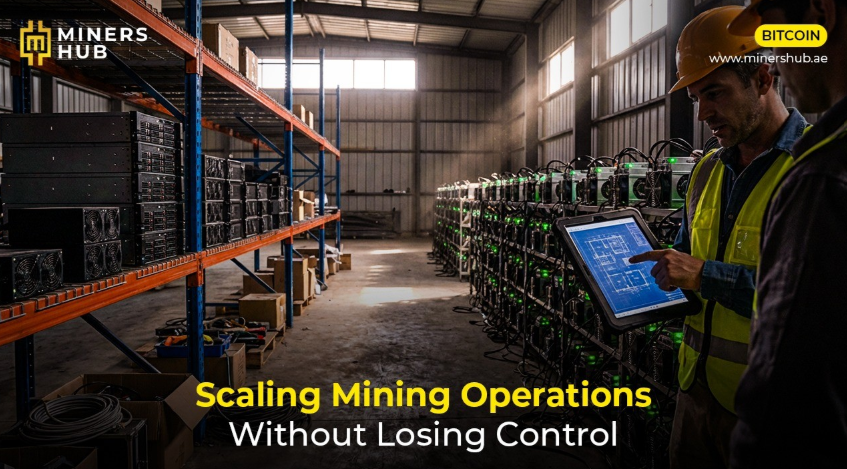
Growth is a natural ambition in mining, but expansion without proper planning often leads to operational instability. Facilities that were perfectly adequate for dozens of machines can struggle dramatically when hundreds or thousands are added.
The difference between successful scaling and costly disruption lies in infrastructure discipline.
MINERS HUB approaches scale as an engineering challenge rather than a race to install more hardware.
Why Scaling Is More Than Adding Machines
Every additional rack increases:
• Power demand • Heat output • Network traffic • Maintenance complexity • Security exposure • Operational coordination
Without systems designed for growth, these pressures can overwhelm existing infrastructure, resulting in outages, overheating, or maintenance bottlenecks.
Professional scaling requires foresight at every layer of the facility.
Modular Architecture as the Foundation of Growth
The most scalable farms are built around modular components that can be replicated quickly and reliably.
These include:
• Standardized rack designs • Pre-engineered power corridors • Expandable cooling zones • Plug-and-play network modules • Dedicated service aisles
MINERS HUB structures its facilities so that new capacity can be added in predictable increments, minimizing disruption to live operations.
This modular approach allows growth to proceed smoothly rather than in disruptive construction phases.
Oversizing Critical Systems
One of the defining features of professional-grade facilities is intentional headroom.
Electrical rooms, cooling plants, and network backbones are often built larger than immediate needs require, allowing additional racks to be deployed without replacing core systems.
MINERS HUB incorporates this philosophy into farm design, ensuring that expansions leverage existing infrastructure instead of forcing costly redesigns.
Centralized Monitoring at Scale
As operations grow, visibility becomes increasingly important.
Centralized monitoring platforms allow operators to:
• Track performance across thousands of machines • Identify underperforming racks • Detect thermal anomalies • Monitor power draw trends • Coordinate maintenance schedules
At MINERS HUB, scale is managed through data. Real-time dashboards and analytics tools provide teams with a facility-wide view, enabling proactive intervention before localized issues spread.
Staffing and Process Discipline
Human systems must scale alongside physical ones.
Large farms rely on:
• Standard operating procedures • Tiered response protocols • Shift-based technical teams • Training programs • Documentation systems • Spare-parts logistics
MINERS HUB invests heavily in operational process design, ensuring that teams can support expanding deployments without sacrificing response times or quality.
Maintaining Stability During Expansion
Adding new machines often introduces thermal and electrical shifts that affect nearby racks.
Professional expansion plans include:
• Staged deployment schedules • Load testing before full activation • Temporary monitoring intensification • Cooling recalibration • Electrical audits
These measures help maintain stability while capacity increases.
MINERS HUB treats each expansion phase as an engineering project, complete with testing, validation, and performance benchmarking.
Why Controlled Growth Outperforms Rapid Deployment
While rapid expansion may appear attractive, uncontrolled growth often leads to:
• Frequent outages • Increased maintenance costs • Accelerated hardware degradation • Security gaps • Operational chaos
Controlled, infrastructure-driven scaling delivers the opposite:
• Stable uptime • Predictable performance • Lower long-term risk • Efficient use of capital • Sustainable growth trajectories
MINERS HUB positions disciplined scaling as a core service offering.
Because in industrial mining, growth is only valuable when it remains under control.