
Uncategorized
UAE Summer Heat Is Now a Fleet Uptime Problem
By Abdulrahman Sharif · August 22, 2026
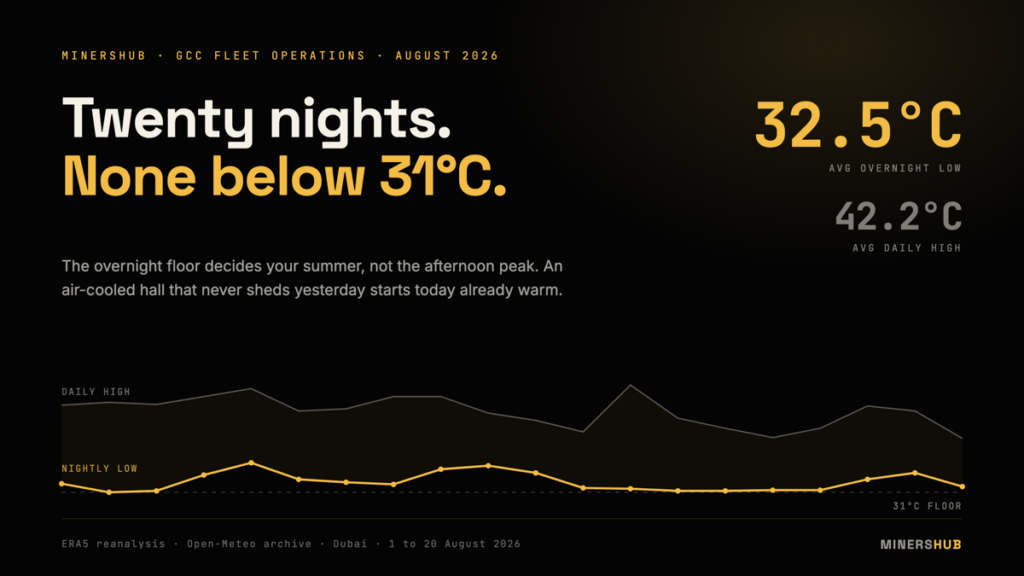
Between 1 and 20 August the coldest hour of the Dubai night averaged 32.5°C. Twenty nights, none of them below 31°C, with the hottest afternoon of the run at 45.9°C. Those figures come from ERA5 reanalysis in the Open-Meteo archive, pulled on 22 August 2026, and the rest of the numbers here were checked the same day.
The night number decides your summer
Most operators quote the afternoon peak. The overnight floor matters more, because it tells you whether the hall ever sheds what it stored during the day. For a given airflow and a given set of heat-rejection equipment, how much heat you can move out drops as the gap between your exhaust air and outside air narrows. At 32°C outside at three in the morning there is not much gap left to work with, and what the hall did not shed overnight is still in the building when the sun comes up.
Dubai averaged 42.2°C daily max across those twenty days. Checking that against your nameplate gets annoying quickly, because published third-party listings for the S21 XP air SKU disagree with each other, one showing a 40°C ceiling and another 45°C. Whichever figure your own documentation carries, it describes air arriving at the intake rather than air in the room. At 3,645 W per box those are two different temperatures, and a restricted intake path or exhaust blowing back into the aisle makes them very different.
One sensor bolted to a wall three metres from the intake will read low, and it will keep reading low all summer whether the fleet is fine or cooking.
We operate 21 farms across the UAE and Oman, and the hosting tiers got their shape from this month rather than from March.
The network does not adjust for your ambient
On 22 August 2026 the chain sat at block 963,566, with difficulty at 127.48 T against roughly 920 EH/s on a three-day average, and the next retarget 82 blocks ahead at height 963,648 (mempool.space). The one before it moved up 0.99% on 8 August.
Difficulty runs on its own schedule. Every hour a machine spends down-clocked, the blocks still get found, just by somebody whose site is cooler. The loss never appears as downtime in any report you would normally open, which is why summer derate goes unbilled for years at a time, in the same way that hosting economics get judged on the wrong number.
Five readings to pull off your fleet this week
- Intake air temperature at 15:00, taken at the machine face. Not the wall thermostat, not the building management readout.
- Chip temperature per hashboard at that same hour, not the single summary figure on the status page. Where you read it depends on the interface: the 4028 stats output on stock BMMiner exposes board temperatures as temp_pcb1, temp_chip1 and so on, while Bitmain’s current HTTP stats endpoint returns temp_pcb and temp_chip as arrays under each chain.
- Fan speed, which is a tach reading and not a duty figure. The fan1 and fan2 values in stats are RPM, while PWM duty lives separately in config as bitmain-fan-pwm, so compare the RPM against the model’s ceiling rather than against 100%. Hours parked at that ceiling mean the airflow headroom is already spent.
- Hashrate at 15:00 and again at 03:00, read off GHS 5s rather than GHS av. GHS av is computed over total hashes since the miner started, so on a machine with long uptime it can absorb most of an afternoon of derate and still hand you a healthy-looking number. After a recent restart it moves faster and hides less.
- Hours per week the fleet spends below rated.
The 03:00 reading is the one people skip, and it is the one that separates the two problems. If intake temperature drops close to outdoor ambient overnight and then spikes in the afternoon, start with the airflow path: filtration, aisle separation, exhaust recirculation, fan capacity. If intake stays high overnight while outdoor air is falling, you are looking at heat rejection or at an ambient limit, and neither gets solved with ducting. Thermal mass, a blocked night purge and trapped roof heat all read the same way at first, so the week of data matters more than any single night.
Send those five readings with your power band and we will tell you where the fleet belongs. Tier 01 hosts air fleets from 50 to 500 kW at 97% uptime. Tier 02 takes 500 kW to 1 MW onto hydro-cooled or immersion at 98%. Tier 03 covers 1 to 3 MW builds at 98% with cooling scoped to the site. The power band gives us the tier and the readings give us the cooling, and if you sit on the coast with salt in the fan bearings, that pushes toward immersion whatever the derate says.
Three paths, and what each one holds
Hydro-cooled is a sealed water-glycol loop with cold plates against the hashboards. The miner ties into a facility hydro circuit, a CDU carries the heat out to a dry cooler, and nothing is submerged at any point. The Antminer S23 Hyd 580T runs 580 TH/s at 5,510 W for 9.5 J/TH, per its product page on our shop.
Factory immersion means full submersion in single-phase dielectric fluid, on hardware built for it. Board layout, sealed bearings and firmware all come tuned from the factory, so warranty treatment is cleaner than an aftermarket conversion, though we still confirm the handling per SKU before quoting. The S21 XP Imm 300T runs 300 TH/s at 4,050 W for 13.5 J/TH. What it removes from your maintenance calendar is most of the calendar: dust ingress, fan bearing replacement, heatsink corrosion, filter cleaning. What it adds is fluid handling, filtration checks and a pump loop that somebody has to know how to service, which is part of what a hosted tier covers.
Aftermarket immersion conversion is the path for hardware you already own. Fans and shrouds come off, TIM gets refreshed, boards go into single-phase dielectric on a closed pump loop. We assess S19, S21 air, M30 and M50-class machines for it, checking board condition and warranty position first.
Worth bookmarking, because it catches people out: the S21 XP Imm 300T and the S21 XP 270T air SKU are both rated 13.5 J/TH on our shop. Identical on paper. What separates them is what happens to that rating when intake air is 42°C, which is a site question rather than a spec question, and it is why we ask for readings before quoting a tier.
Two positions, since both come up in scoping calls. We do not spec two-phase immersion on new builds, because single-phase carries the production record and the fluorocarbon supply behind two-phase is closing. And immersion does not end hardware failure, whatever the tank vendors imply. It takes dust, fan bearings and salt-air corrosion off the heat path, which in the GCC is most of the failure list and not the whole of it. Boards still fail, and our repair centre in Al Ain still gets them, at which point the repair or replace maths takes over.
Where a fleet lands with us
| Tier | Power band | Cooling | SLA | Published power cost |
|---|---|---|---|---|
| Tier 01 | 50 to 500 kW | Air | 97% | $0.067/kWh |
| Tier 02 | 500 kW to 1 MW | Hydro-cooled and immersion | 98% | $0.067/kWh |
| Tier 03 | 1 to 3 MW | Mixed, scoped per build | 98% | $0.067/kWh |
Source: minershub.ae/hosting.
We run 50 MW across those 21 farms, with 4.5 MW of UAE capacity open at the moment and a front line under 10 J/TH. Eight years of operating in this climate is what collapsed the offer into three tiers instead of six.
The thing worth being blunt about is timing. An air fleet can be hashing inside roughly ten days of greenlight. Hydro-cooled and immersion are custom infrastructure builds needing four to twelve weeks depending on the site, which is why this decision belongs in August rather than in the quiet of November, when the readings that justify it have gone away for another year.
FAQ
How much hashrate does an air-cooled fleet lose in a GCC summer?
Measure it rather than take a blanket figure from anyone, us included. GHS 5s at 15:00 against GHS 5s at 03:00, sampled across a week, gives you your own derate curve rather than an industry average that was measured somewhere with cheaper nights.
Is immersion worth it for a 100-machine fleet?
Size it in kilowatts, not machine count. A 100-unit S21 XP air fleet draws roughly 365 kW at 3,645 W per box, so the first quote is Tier 01 air hosting. If the readings show real derate, or the hardware plan is growing past that band, we scope the move into Tier 02 hydro-cooled or immersion rather than letting machine count make the decision.
Can I convert the air miners I already own instead of buying immersion SKUs?
Yes, and it is the usual path for an S19 or S21 air fleet that still has service life in it. Warranty treatment differs from factory immersion SKUs, so that conversation happens before anything is stripped.
Before the next retarget
Pull the five readings while the season is still producing them. Send us the 15:00 and 03:00 numbers with your SKU list, power band and site location, and our hosting team will come back with the tier that fits the fleet you have.
WhatsApp +971 58 862 2898, or start at minershub.ae/hosting.